How to Replicate a Viral TikTok Video (Without Reposting Anyone's Footage)
The bottleneck in viral video replication isn't finding the video. It's breaking down what actually makes it work — and applying that skeleton to your own SKU before the trend cools.
What "viral replication" actually replicates
Same hoodie, same price, same model swapped in — one clip clears 80,000 units, the copy stalls at 3,000 views. The product wasn't the difference. The structure was.
Anyone who's run TikTok Shop for a year has watched this happen. The gap between the winner and the reshoot isn't camera quality. It's that the viral clip nailed the choreography — where the hook lands, how dense the cuts are, when the BGM hits — and the reshoot copied the aesthetics but flattened the timing.
The skeleton worth replicating is these seven things:
- Hook placement — TikTok watch-through is decided in the first 1.5 seconds. Viral hooks land in the 0.0–1.5s window, almost every time;
- Cut density — 4 cuts in 15 seconds vs 7 cuts changes the perceived information rate;
- Lighting direction — front, side, or back light dictates how the product reads;
- Character choreography — how the product is held, dwell time on the label, micro-expressions;
- BGM beat mapping — which frame the kick drum lands on, and which cut it triggers;
- Transition style — hard cut, match cut, whip pan;
- End-frame CTA — "tap the yellow cart" as a closing beat vs a persistent overlay throughout.
Those seven things stitch into a video's skeleton. The skeleton is portable. The skin — footage, product, actor — must be swapped for yours. Copying the file is a policy violation; copying the skeleton is what the platform actively rewards.
Why manual teardowns don't scale
An experienced short-video operator can break down one viral clip's skeleton in about 25 minutes: frame-by-frame scrubbing, timecode marking, script rewriting, BGM beat tagging. Ten reference clips is a four-hour afternoon — and that's the analysis alone, before any shooting.
The output isn't drop-in either. You end with a spreadsheet that says "0.8s reveal / 3.2s tight product / 8.5s beat drop," and you still need to translate that into either a shooting script for humans or a prompt for an AI video model. Another 15 minutes per clip.
Automating this with a general-purpose agent — Codex, Claude Code, OpenClaw — is possible in theory. Two things block it in practice: most agents don't ship with frame-sampling and OCR out of the box, and even after you extract the structure you still need to wire the video-model API yourself. That's the wiring Clipcat collapsed into a 30-second button.
The Clipcat replication loop
Pick a target from the shopping-tagged leaderboard
Filter by category (beauty, phone cases, pet snacks, fast fashion, etc.) and by market — 15+ TikTok Shop regions. Only show clips in the top 5% for views over the last 24 hours or 7 days with a live product tag. Skip pure entertainment virality: it lifts views but not conversion.
Extract the skeleton: nine-field prompt in 30 seconds
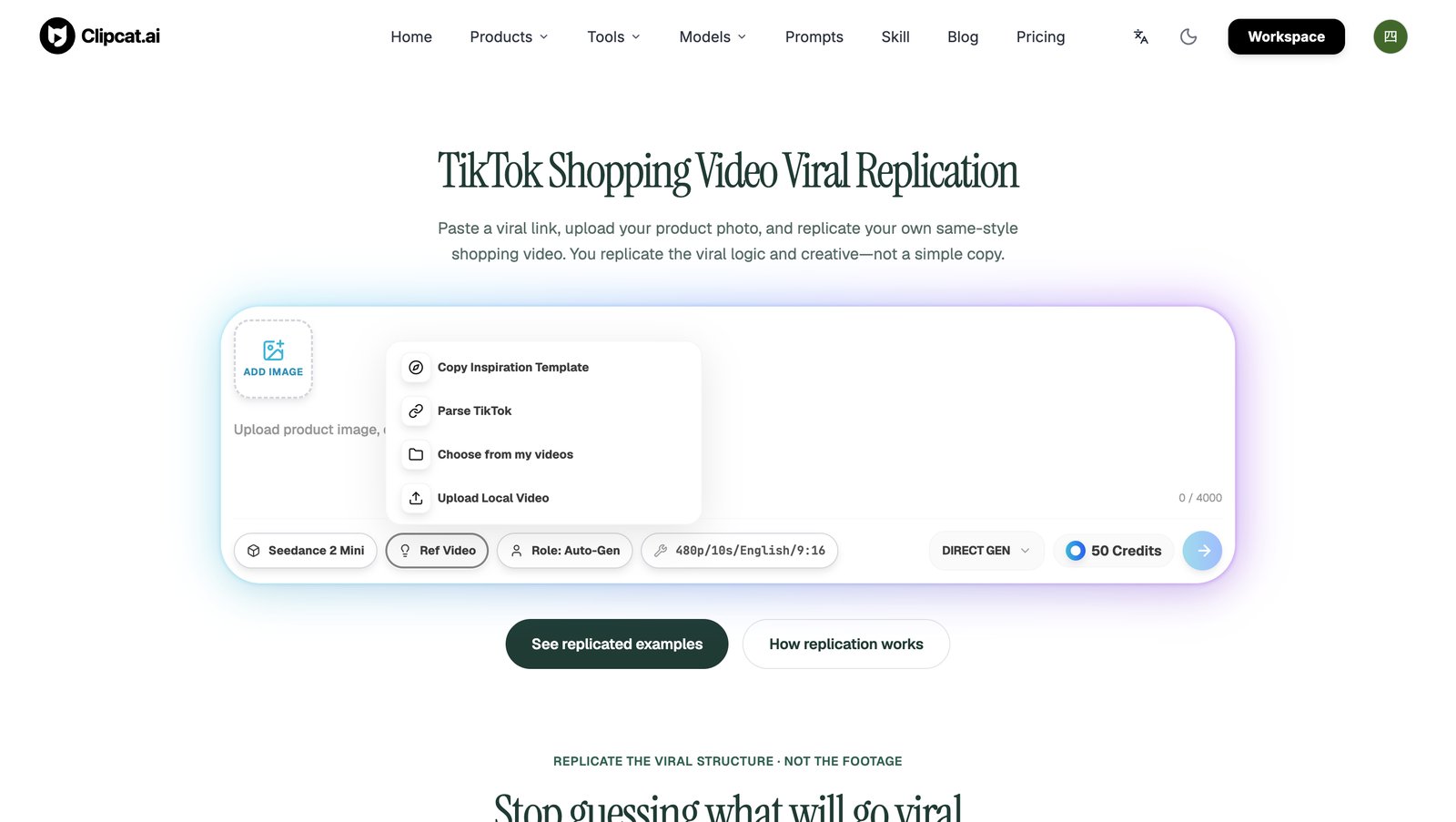
Hit Replicate. The engine samples frames, detects cut points, extracts BGM features, and emits a nine-field prompt — style, camera, lighting, character, timestamped shots, sound, transition, duration, background.
Swap the skin: your product photo, your actor
Drop your product image. Pick an AI actor or a saved consistent character (so the same face carries across every clip in the series). The original creator's likeness gets replaced with the actor you selected — skeleton preserved.
Choose a model by budget and look
Seedance 2 is the cheapest and fastest. Grok Imagine 1.5 handles product lighting best. Veo 3.1 nails human motion. Sora 2 handles complex scenes. Run the same prompt through three models in parallel and pick the winner.
Fan out: same skeleton, 10 SKU variants
Keep the skeleton, swap the product photo and actor combo across a SKU group. Ship all 10 variants. Let TikTok Shop's own CTR/CVR pick the top 20% for scaling; kill the 80% cleanly. That's where replication actually saves money.
End-to-end runs about 3-5 minutes per finished clip once you're warm. Leaderboard entry point here.
How this differs from CreatOK / TikTokCopy
The category has two other Chinese-built replication tools on the market — CreatOK and TikTokCopy. Close in positioning, different in product surface.
| Capability | Clipcat | CreatOK | TikTokCopy |
|---|---|---|---|
| Leaderboard market coverage | 15+ TikTok Shop regions | US + Southeast Asia mostly | Single market |
| Skeleton extraction granularity | 9 fields (incl. timestamped shots, transitions, BGM beat) | 4 fields (style, character, scene, duration) | 3 fields |
| Model choice | Seedance 2 / Grok / Veo 3.1 / Sora 2 switchable | Seedance 2 only | Seedance 2 only |
| Output spec | 1080P optional, 15/30/60s | 480P + 15s | 480P + 15s |
| Consistent character | Reuse the same face across clips | Regenerated every time | Regenerated every time |
| Agent Skill (callable from Codex / Claude Code) | Yes | No | No |
The load-bearing difference is skeleton granularity. A four-field breakdown gets you a video that looks similar. A nine-field breakdown gets you a video that behaves similarly — the completion curve tracks the reference clip's, which is what actually decides ad performance.
Four traps sellers hit
1. Replicating entertainment virality instead of shop virality
The absolute top of the leaderboard is often comedy or skit content, not shopping-tagged. Replicating one of those lifts views but tanks conversion. Rule one: filter to clips with a live yellow-cart tag.
2. Ignoring BGM licensing
TikTok's commercial music library and its consumer library are not the same. Business accounts that use non-commercial audio get throttled, sometimes taken down. The BGM your leaderboard clip is using needs to be re-verified against the TikTok Business Music Library — or replaced with a licensed track of similar tempo, which Clipcat's replication does automatically.
3. Regenerating the original KOL's face
Generating an AI actor whose face is a near-match to the source creator is a likeness-rights violation. Every replicated video's on-screen character must be a synthetic actor or talent you have signed release for. Clipcat's default flow only lets you pick from the AI actor library or your own saved characters, so the trap is closed at the system level.
4. Betting the campaign on one skeleton
Even a proven skeleton hits your SKU with variance. The pattern that actually works is 1 reference → 5–10 variants → top 20% survives. Treat replication as a hypothesis pipeline, not as a stamp. The teams that scale on TikTok Shop iterate weekly on skeletons, not quarterly.
FAQ
What does it mean to replicate a viral TikTok video?
Replication means lifting the structure of a proven video — hook timing, cut density, lighting direction, character choreography, BGM beat placement — and applying that structure to your own product. It is not reposting the file. Reposting is a policy violation; replicating the structural pattern is how sellers ride content that already works.
How do you replicate a TikTok in Clipcat?
Open the Clipcat viral leaderboard, filter by category and market from the 15+ TikTok Shop regions, pick a video that is actually shopping-tagged, and hit Replicate. The system breaks it into a nine-field prompt (style, camera, lighting, character, timestamped shots, sound, transition, duration, background). Upload your own product photo, pick an AI actor or a saved consistent character, choose a model (Seedance 2, Grok Imagine, Veo 3.1, or Sora 2), and generate. Under 5 minutes end to end.
Is replicating a viral TikTok legally safe?
Camera language and pacing are not copyrightable — the structure itself is fair game. The two real risk points are the original soundtrack (you must pull BGM from TikTok's Business Music Library, not scrape the source audio) and the original creator's face (never regenerate a real KOL's likeness; use AI actors or your own UGC talent). Clipcat's default flow forces both.
Why not just hire a UGC creator or agency?
A UGC creator charges US$30-80 per video with 3-5 day turnaround, plus revision cycles for hook, angle, and lighting. Testing 10 hooks equals US$300-800 and two weeks. Clipcat's per-video cost lands in single-digit dollars at Pro-tier usage and delivers in minutes. The difference isn't speed — it's whether you can afford to iterate at all.
Will one replicated video make my SKU take off?
No. Same structure over different SKUs produces uneven completion rates. The working recipe is to derive 5-10 variants from one viral structure, push them all live, and let TikTok Shop's own CTR and CVR data pick the top 20% for scaling. The point of replication isn't finding one perpetual-motion video — it's collapsing the cost of hypothesis-generation so your test budget goes into paid, not into scripting.
Next step
Pick a 24-hour top clip in your own product category, run it through Clipcat's viral leaderboard and one-click replicate, and ship your first structurally-matched cut. When you A/B, log the CTR delta between the top-20% variants and the killed ones — that gap is your category's actual return on structural replication.
Running an agent stack? See Codex × Clipcat Agent Skill orchestration for wiring replication into a full TikTok Shop automation loop.