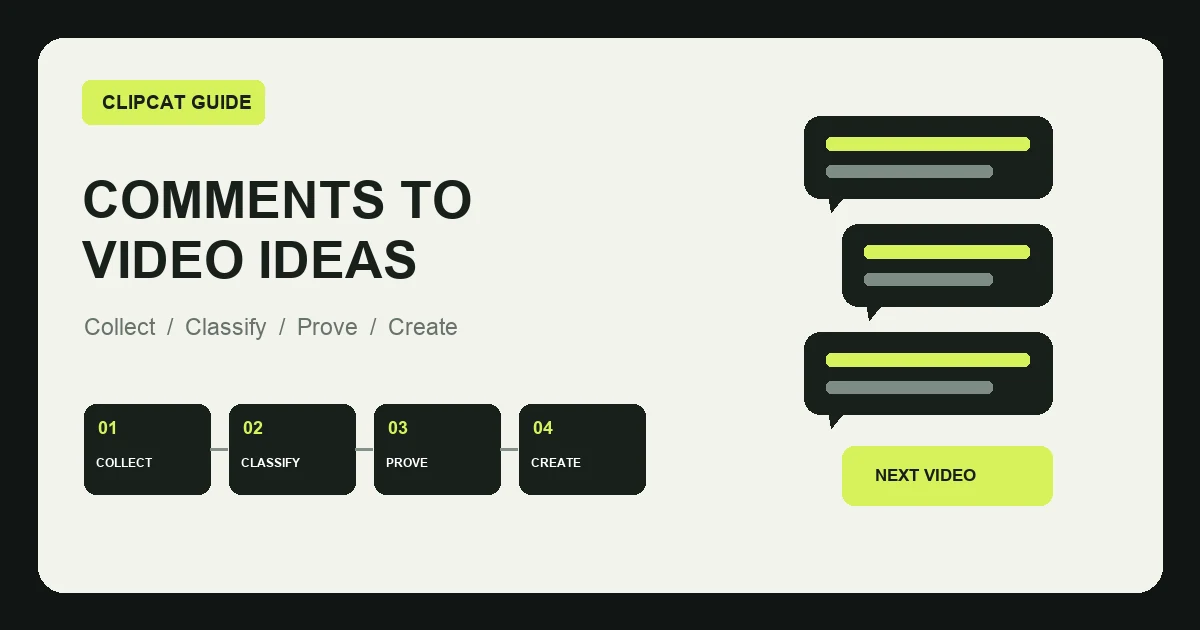
TikTok Shop teams often run out of ideas before they run out of products. After unboxings, demonstrations, talking-head posts, and before-and-after videos, the next topic becomes unclear. Customer comments provide a more durable source: questions that viewers still need answered.
Why are comments useful for content planning?
Product briefs speak from the brand's perspective. Comments reveal the buyer's decision process: Will it fit in my bag? Is it difficult to clean? Does it work with my device? What is included?
1. Define the comment sample
Use comments on your own posts, public product Q&A, popular category videos, creator partnerships, and recurring pre-sale or support questions. Prioritize comments tied directly to function, use, setting, specifications, and purchase objections. Filter emoji-only reactions, generic praise, and unrelated arguments.
2. Sort questions into five types
Function
What does the product do, fold, adjust, or support? Best answered by demonstration.
Use
How do I install, clean, remove, or store it? Best answered by a step sequence.
Situation
Does it work in a dorm, office, suitcase, or outdoor setting? Best answered in context.
Specification
What size, color, version, packaging, and accessories are included? Best answered by comparison or unboxing.
Objection
Is it hard to operate, carry, or maintain? Answer with verified facts and observable proof.
3. Prioritize questions worth filming
| Factor | Question to ask |
|---|---|
| Frequency | Does the question repeat across posts or conversations? |
| Decision impact | Could uncertainty stop further interest or purchase? |
| Visual potential | Can a video answer it clearly? |
| Evidence quality | Do you have accurate information and proof assets? |
Prioritize questions that are frequent, decision-relevant, and easy to demonstrate. Do not improvise answers to unconfirmed future features or specifications.
4. Turn the comment into a hook
Keep the logic, not necessarily the exact wording. “Will this take up too much desk space?” can become: “Will it fit on a small desk? Let's compare it with a keyboard and mug.” The rest of the video must answer the opening.
5. Design visual proof for each answer
| Question | Proof shot |
|---|---|
| Will it fit in a commuter bag? | Place it in a common backpack and show remaining space |
| Is it difficult to clean? | Show disassembly, cleaning, and reassembly |
| What is the real capacity? | Add specific everyday items one by one |
| Which size should I choose? | Compare both under the same conditions and explain use cases |
6. Build a one-question, one-video backlog
Track the question, audience, format, proof shot, fact source, and production status. Combine closely related questions where useful, but separate unrelated ones so each short video has a clear answer.
How can Clipcat expand the research sample?
When your account has limited comments, research public TikTok content around the product, use case, and customer problem. Clipcat can help discover popular ecommerce videos, organize relevant examples, and analyze script and visual structure.
Use the TikTok selling-video prompt library to study related formats, the reverse video prompt tool to map proof shots, and the AI TikTok video generator to create question-led test assets.
Clipcat does not replace manual question classification, fact checking, or prioritization, and public comments should never be used to infer a person's private data.
7. Turn recurring questions into a series
- Before you buy: size, versions, specifications, and package contents.
- How it actually works: setup, operation, cleaning, and storage.
- Will it fit your situation? office, dorm, travel, and home tests.
- Common mistakes: correct use without manufacturing fear.
Each answer video may produce the next useful question. Add those comments back into the backlog and keep the cycle running.
Avoid turning answers into hard-sell ads
- Answer the question before adding product adjectives.
- Use measurements, operations, and real settings as evidence.
- State limits when a product does not fit every situation.
- Do not fabricate a comment or impersonate a customer.
- Avoid claims such as “works for everyone” or “never fails.”
Where can AI help?
AI can organize scripts, generate hook variants, split an operation into shots, create talking-head or demonstration material, and adapt one question for several languages. Give the tool the audience, exact question, proof action, and product constraints. Review the product, movement, captions, and claims before publishing.
Pre-publish checklist
Real question
Based on recurring public questions or genuine business feedback, without impersonating a customer.
Accurate answer
Facts are verified, conditions are clear, and the listing agrees.
Visible proof
Measurements have references, steps are complete, and comparisons use equal conditions.
Compliant assets
People, music, and footage are authorized and meet platform rules.
Frequently asked questions
Can this method work when my account has very few comments?
Yes. Research public category videos, product questions, and genuine sales feedback, but treat them as content signals rather than complete market conclusions.
Can one TikTok video answer several comments?
Closely related questions can be combined. Unrelated questions are usually clearer as separate videos.
Should a brand make videos about negative comments?
It can answer real, recurring concerns with facts. Avoid public arguments, personal attacks, and disclosure of personal information.
How can Clipcat support comment-driven content research?
Clipcat can expand public TikTok content research, analyze structure, and assist production. Humans still classify questions and set priorities.
Do comment-led videos require a human presenter?
No. A product demonstration, captions, digital presenter, or first-person operation may be more appropriate for the question.
Final takeaway
A sustainable comment-driven workflow is: collect questions, classify them, set priorities, design visual proof, produce one focused answer, and use new comments for the next round. The account becomes a useful decision resource instead of repeating the same product claims.