AI can turn a blank page into ten script ideas in seconds. That does not mean all ten are shootable. The most useful change is not simply producing more copy; it is giving the model a structure in which every claim has a visual job.
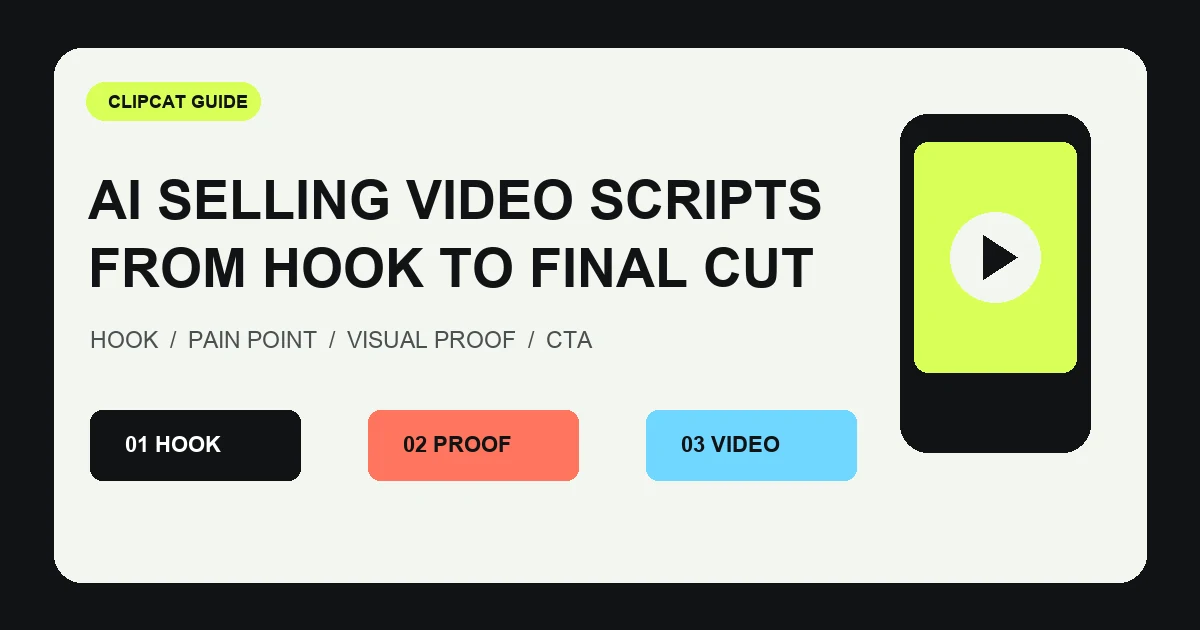
1. The four-part selling script
The first three seconds should qualify the audience
A hook does not need to be loud. It needs to be relevant. A surprising conclusion, a recognizable frustration, or the final result shown first can work. “Why is your desk messy again the morning after you clean it?” is more useful than “Meet our new organizer.”
Turn a generic pain point into a filmable moment
“Save time” is abstract. “Spend ten fewer minutes styling your hair before work” gives the viewer a person, place, action, and outcome. Specific scenes create identification and give the video model something concrete to render.
Attach visual proof to every benefit
One primary benefit and one or two supporting points are enough for a 15-second video. Show water rolling off a waterproof surface, debris disappearing under suction, or a removable tray being rinsed. If a benefit cannot be observed, it should not dominate the script.
Close with one low-friction action
Tell viewers what to do and why the next step is worth taking. Repeating “buy now” throughout the video usually weakens trust; one clear closing instruction is easier to process.
2. A practical Clipcat script-to-video workflow
General chat tools are useful for copy exploration, but a text-only draft still leaves research, shot planning, and production disconnected. A faster approach starts with a proven creative pattern and rebuilds it around your product.
- Find grounded references. Use Clipcat's viral prompt generator to explore real high-GMV AI selling videos and reverse-engineered prompts. Focus on the hook, proof mechanism, and pacing.
- Analyze the structure. Run a suitable reference through the reverse video prompt tool to study its scenes and timing without copying its product claims.
- Rewrite the purchase reason. Replace the audience, problem, evidence, and tone with facts that belong to your product.
- Move into production. Use the AI TikTok video generator to turn product images and the revised prompt into a selling video, or use viral video replication to adapt the effective structure with newly generated visuals.
3. What to include in an AI script brief
| Input | Be specific about | Avoid |
|---|---|---|
| Audience | Identity, situation, current frustration | “For everyone” |
| Platform | 9:16, duration, UGC or demo style | Unlimited copy |
| Benefit | One primary, up to two supporting | Every specification |
| Proof | Action, comparison, close-up | “Premium” without evidence |
| Constraints | Only verified product facts | Invented metrics or promises |
Write a [platform and duration] selling video script for [product]. The audience is [person] facing [specific problem] in [situation]. Open with [hook type]. Prove [primary benefit] through [observable action]. Address [buyer concern], then close with a natural prompt to [next step]. Output a timeline with voiceover, action, shot size, and on-screen text. Do not add claims that are absent from the supplied product information.
4. Review the AI draft with five checks
- Does the first three seconds stop the intended buyer?
- Does every benefit have a corresponding visual proof?
- Does the voiceover sound natural when read aloud?
- Are appearance, specifications, claims, and offers accurate?
- Does the entire video support one purchase reason?
Let AI generate breadth and let a human apply judgment. Comparing several directions against the same checklist is usually faster than endlessly revising one weak draft.
5. Three common mistakes
Treating copy as a shooting script
A line can sound persuasive and still leave the frame empty. After each sentence, ask what the viewer sees at that moment. Rewrite anything without a concrete answer.
Trying to explain every benefit
More information is not automatically more persuasive. Separate benefits into distinct creatives, then use performance data to learn which purchase reason deserves more production.
Copying a viral video without product fit
Hooks, pacing, and proof patterns can be adapted. The people, scenes, benefits, and claims must come from your own product. Reuse the logic, not someone else's facts.
Frequently asked questions
What structure should a short product video script follow?
Open with a hook for the target buyer, make the pain point specific, prove one main benefit with observable action, and close with a clear next step.
Why should a human review an AI-generated script?
AI can produce options quickly, but a human must verify claims, natural delivery, product accuracy, and whether every line can become a useful shot.
How can Clipcat support the workflow?
Clipcat can help search real high-GMV AI selling videos and reverse-engineered prompts, analyze references, generate videos from product images and prompts, or adapt a proven structure.
Make the script visible, not merely readable
Start with a proven structure, then rebuild every scene around truthful product evidence. Clipcat connects creative research, prompts, and AI video production in one workflow.
Explore selling video promptsReview all AI output against current product information. Product claims, certifications, prices, and promotions should match the live offer at publication.